
Rental yield in Kenya: how to calculate gross and net yield
A simple guide for landlords and agencies on calculating rental yield in Kenya, with worked gross and net yield examples using ISHI Homes rent data.

Before you buy, build or price a rental unit, you need one number: the rental yield. Rental yield in Kenya tells you how much your property earns each year compared with what it cost you. This guide shows you how to work out both gross and net yield, with simple worked examples you can copy for your own units.
What is rental yield?
Rental yield is the yearly rent from a property shown as a percentage of the property's cost.

There are two kinds:
- Gross yield - rent before any costs. Quick, but it flatters the property.
- Net yield - rent after costs like repairs, management, empty months and tax. Slower to work out, but closer to the money you actually keep.
Always look at both. A unit can have a strong gross yield and a weak net yield.
How to calculate gross rental yield in Kenya
The formula:

Gross yield = (monthly rent x 12) / property cost x 100
"Property cost" is what you paid to buy or build. For a truer picture, add buying costs such as legal fees and stamp duty (a tax paid when land or property changes hands).
Worked example: a 2 bedroom apartment
As of 25 Oct 2026, the median rent for a 2 bedroom apartment across ISHI Homes listings is KES 28,000 a month. Say you bought one for KES 6,000,000 (an example price, not a market figure).
- Yearly rent: KES 28,000 x 12 = KES 336,000
- Gross yield: 336,000 / 6,000,000 x 100 = 5.6%
Note: the deposit your tenant pays is not income. You hold it and return it when they leave, less any agreed deductions.
How to calculate net rental yield
The formula:
Net yield = (rent actually collected - yearly costs) / property cost x 100
Common yearly costs for Kenyan landlords:
- Vacancy - months the unit sits empty between tenants
- Management fees - if an agent or company manages the unit, often a percentage of rent collected
- Repairs and maintenance - painting, plumbing, fixing doors
- Service charge - shared costs in an apartment block, such as security, cleaning and lifts
- Caretaker, water and garbage - if you pay these and do not pass them on
- Insurance - cover for the building
- Land rates or ground rent - yearly charges by the county or land owner
- Rental income tax - paid to KRA on rent
Worked example 1: the same 2 bedroom apartment
We will use example figures. Replace them with your own.
| Item | Amount per year |
|---|---|
| Full year's rent | KES 336,000 |
| Less 1 month empty | - KES 28,000 |
| Rent collected | KES 308,000 |
| Management (10% of collected) | KES 30,800 |
| Repairs and maintenance | KES 20,000 |
| Service charge (KES 3,000 a month) | KES 36,000 |
| Insurance | KES 10,000 |
| Land rates | KES 5,000 |
| Rental income tax (7.5% of collected) | KES 23,100 |
| Total costs | KES 124,900 |
| Net income | KES 183,100 |
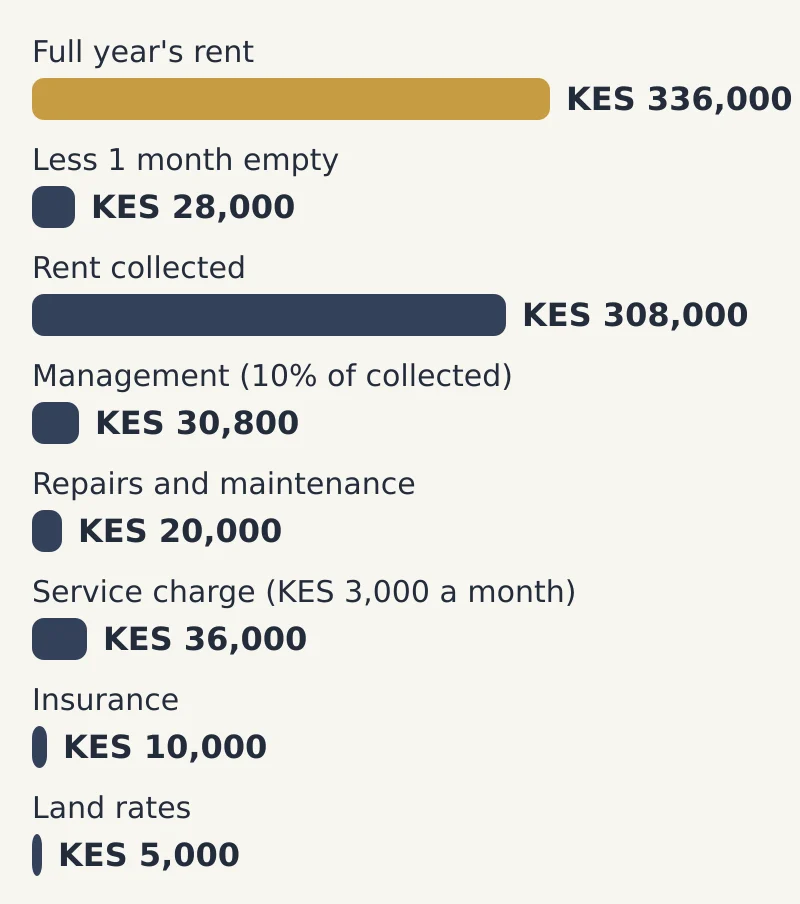
- Net yield: 183,100 / 6,000,000 x 100 = about 3.1%
The gross yield was 5.6%. After costs, it is nearly halved.
Worked example 2: a block of 10 bedsitters
As of 25 Oct 2026, the median bedsitter rent in Kahawa Wendani on ISHI Homes is KES 8,500 a month (based on 3 listings). Say you built 10 bedsitters there for KES 9,000,000 in total (an example cost).
Gross yield:
- Yearly rent: 10 x 8,500 x 12 = KES 1,020,000
- Gross yield: 1,020,000 / 9,000,000 x 100 = about 11.3%
Net yield:
| Item | Amount per year |
|---|---|
| Full year's rent | KES 1,020,000 |
| Less 5% vacancy | - KES 51,000 |
| Rent collected | KES 969,000 |
| Management (10% of collected) | KES 96,900 |
| Repairs and maintenance | KES 60,000 |
| Caretaker (KES 10,000 a month) | KES 120,000 |
| Insurance | KES 20,000 |
| Land rates | KES 10,000 |
| Rental income tax (7.5% of collected) | KES 72,675 |
| Total costs | KES 379,575 |
| Net income | KES 589,425 |
- Net yield: 589,425 / 9,000,000 x 100 = about 6.5%
Gross vs net yield side by side
| 2 bedroom apartment | 10 bedsitters | |
|---|---|---|
| Cost (example) | KES 6,000,000 | KES 9,000,000 |
| Gross yield | 5.6% | 11.3% |
| Net yield | 3.1% | 6.5% |
The lesson: smaller units often show higher yields, but they also bring more tenants, more turnover and more management work. Your costs list must reflect that.
Where to get realistic rent figures
Your yield is only as good as your rent estimate. Do not guess high.
- Check current listings for the same unit type in the same area. ISHI Homes shows real asking rents across Nairobi and its commuter towns.
- As of 25 Oct 2026, ISHI Homes medians include: 1 bedroom in Kahawa Sukari KES 15,750, 1 bedroom in Roysambu KES 18,250, 2 bedroom in Toll (Ruiru) KES 21,250, and 2 bedroom in Kilimani KES 71,500.
- Treat medians from only one or two listings as a rough guide, not a rule.
- Ask local caretakers and agents how long units stay empty.
Common mistakes to avoid
- Counting the deposit as income. It belongs to the tenant.
- Assuming 12 full months of rent. Allow for empty months and late payers.
- Forgetting tax. Rental income tax is charged on rent, so budget for it every month.
- Using today's price for an old property. For a property you already own, you can use its current market value to compare it with other investments.
- Ignoring big future repairs. Roofs, tanks and pumps wear out. Set money aside.
What is a good rental yield?
There is no single right number. Compare your net yield with what your money could earn elsewhere with less effort, such as a fixed deposit or government securities. Check current rates before you decide. If your net yield is not clearly higher, ask whether the extra work and risk are worth it. Also remember that property value may rise over time, which yield alone does not show.
Track your real yield with ISHI
Working out yield once is easy. Keeping it accurate month after month is harder, because rent payments, arrears, repairs and empty units keep changing. ISHI property management software keeps rent collection, expenses and tenant records in one place, so you can see what each unit really earns.
See ISHI in action:
- Book a free demo at www.ishi.digital/contact
- Call 0116888777
- Email hello@ishi.digital
Questions people ask
How do I calculate rental yield in Kenya?
Multiply the monthly rent by 12, divide by what the property cost, then multiply by 100. That gives gross yield. For net yield, subtract yearly costs like vacancy, repairs, management and tax from the rent first.
What is the difference between gross and net rental yield?
Gross yield uses rent before any costs. Net yield uses rent after costs, so it shows the money you actually keep and is usually much lower.
Is the tenant's deposit part of rental income?
No. The deposit is the tenant's money that you hold and return when they leave, less any agreed deductions, so leave it out of your yield calculation.
Do I pay tax on rental income in Kenya?
Yes. Residential landlords pay rental income tax to KRA on rent received. Check the current rate and rules with KRA or a tax adviser, as they can change.
What is a good rental yield in Kenya?
It depends on the area, unit type and your goals. A useful test is whether your net yield beats what you could earn from lower-effort options like fixed deposits or government securities.
Should I include buying costs in the property price?
Yes, for a truer picture. Add costs such as legal fees and stamp duty to the purchase price before working out yield.
Keep reading

Rent reminder messages that get paid: SMS and WhatsApp templates
Copy-and-paste rent reminder templates in English and Kiswahili for SMS and WhatsApp, from a friendly early nudge to a final arrears notice, plus a simple sending schedule.
25 October 2026 · 7 min read
Property management fees in Kenya: what agencies charge
A plain guide to property management fees in Kenya: common ranges for management and letting fees, the extra charges to watch for, and how to work out what a fair deal looks like for your building.
25 October 2026 · 7 min read
Monthly rental income tax in Kenya: who pays, how much and how to file
A plain guide to monthly rental income tax in Kenya for landlords and agencies: who it covers, the current rate, worked examples using real rents, and how to file and pay on iTax.
25 October 2026 · 6 min read