
Monthly rental income tax in Kenya: who pays, how much and how to file
A plain guide to monthly rental income tax in Kenya for landlords and agencies: who it covers, the current rate, worked examples using real rents, and how to file and pay on iTax.

If you earn rent from a house or flat, you probably owe monthly rental income tax in Kenya. This tax is called MRI for short. It is simple once you know the rules. You pay a flat rate on the rent you collect, every month, through KRA's iTax system.
This guide explains who pays, how much, and how to file. It uses real rents from ISHI Homes listings to show the sums.
Important: Tax rules change, often through the yearly Finance Act. The rate and limits below are correct to the best of our knowledge at the time of writing. Always confirm the current figures on the KRA website (kra.go.ke) or with a tax adviser before you file.
What is monthly rental income tax?
Monthly rental income tax is a tax on the rent you earn from residential property. Residential means homes people live in: bedsitters, apartments, bungalows and maisonettes.

Key points:
- It is charged on gross rent. Gross rent is the full rent you receive, before you take off any costs.
- You cannot deduct expenses such as repairs, service charge, land rates or loan interest.
- It is a final tax. This means once you pay it, you do not declare that rent again in your annual income tax return.
Who pays monthly rental income tax in Kenya?
MRI applies to Kenyan residents - both individuals and companies - who earn residential rent within this yearly band:
| Yearly residential rent | What applies |
|---|---|
| Below KES 288,000 | Not under MRI. Declare the rent in your annual income tax return. |
| KES 288,000 to KES 15,000,000 | MRI at 7.5% of gross rent, filed monthly |
| Above KES 15,000,000 | Not under MRI. Rent is taxed under normal income tax rules, where expenses can be claimed. |
KES 288,000 a year works out to KES 24,000 a month. Add up rent from all your residential units, not just one.
The landlord pays the tax, not the tenant. An agent or property manager can file and pay on the landlord's behalf, but the landlord stays responsible if it is not done.
MRI does not cover:
- Commercial property such as shops, offices and warehouses. That rent is taxed under normal income tax rules, and some tenants deduct withholding tax before paying you.
- Non-resident landlords. Rent paid to a non-resident is usually subject to withholding tax, which the tenant or agent deducts.
How much is the rate?
The current MRI rate is 7.5% of gross rent. It came down from 10% under the Finance Act 2023, starting 1 January 2024.
The formula is simple:
Tax due = rent received in the month x 7.5%
Worked examples
These examples use median rents from ISHI Homes listings, as of 25 Oct 2026.
Example 1: One 1 bedroom flat
Amina rents out one 1 bedroom apartment at KES 15,750 a month (the median across our listings).
- Yearly rent: KES 15,750 x 12 = KES 189,000
- This is below KES 288,000, so Amina is not under MRI.
- She declares the rent in her annual income tax return instead.
Example 2: One 2 bedroom flat
John rents out a 2 bedroom apartment at KES 28,000 a month.
- Yearly rent: KES 336,000 - inside the MRI band
- Monthly tax: KES 28,000 x 7.5% = KES 2,100
- Yearly tax: KES 25,200
Example 3: A block of bedsitters
Mary owns 10 bedsitters in Kahawa Wendani, each at KES 8,500 a month.
- Monthly rent: KES 85,000
- Yearly rent: KES 1,020,000 - inside the band
- Monthly tax: KES 85,000 x 7.5% = KES 6,375
If two units are empty one month and she collects KES 68,000, her tax that month is KES 5,100. You pay on rent actually received.
Example 4: Higher-end flats
A company lets four 2 bedroom apartments in Kilimani at KES 71,500 each.
- Monthly rent: KES 286,000
- Yearly rent: KES 3,432,000 - inside the band
- Monthly tax: KES 286,000 x 7.5% = KES 21,450
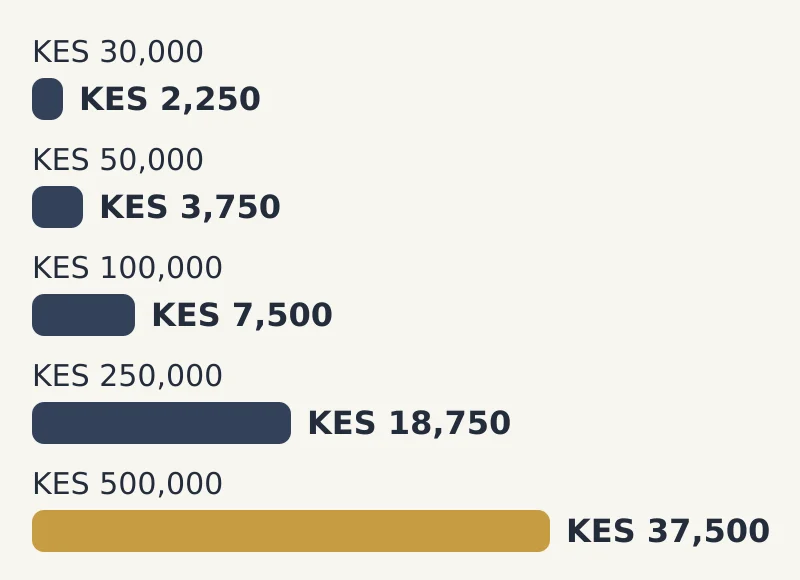
Quick table
| Monthly rent collected | MRI at 7.5% |
|---|---|
| KES 30,000 | KES 2,250 |
| KES 50,000 | KES 3,750 |
| KES 100,000 | KES 7,500 |
| KES 250,000 | KES 18,750 |
| KES 500,000 | KES 37,500 |
What counts as rent?
- Monthly rent you receive counts.
- Deposits you hold and later refund are not rent.
- If you keep a deposit to cover unpaid rent, that money becomes rent and is taxed in the month you keep it.
- Rent paid in advance is generally taxed when you receive it.
- If you collect nothing in a month, you still file - a nil return.
How to file and pay on iTax
You need a KRA PIN with the rental income obligation added. If your PIN does not show it, add it on iTax or ask at a KRA office.
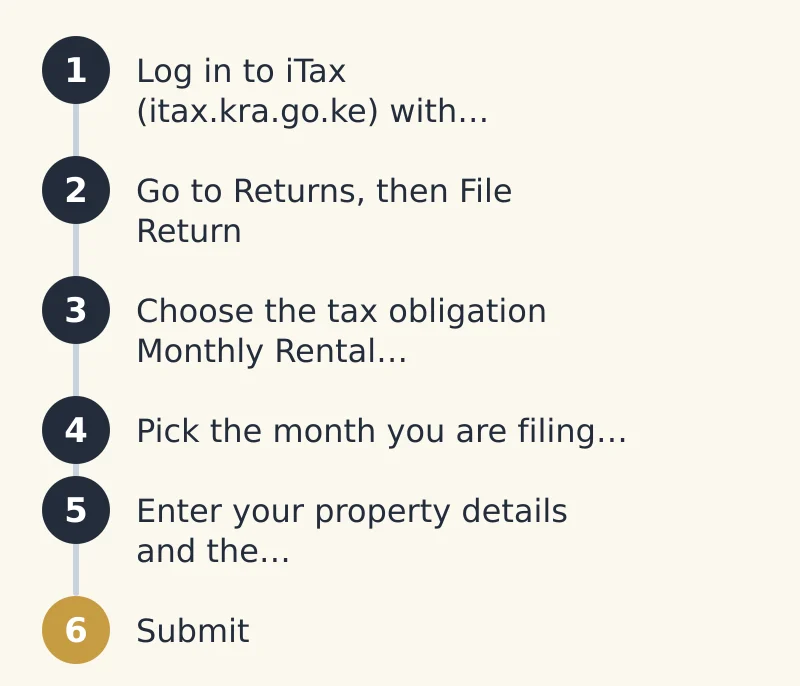
Steps:
- Log in to iTax (itax.kra.go.ke) with your PIN and password.
- Go to Returns, then File Return.
- Choose the tax obligation Monthly Rental Income.
- Pick the month you are filing for.
- Enter your property details and the rent received from each unit.
- Submit. iTax works out the tax for you.
- Generate a payment slip.
- Pay through M-Pesa (KRA Paybill), bank or other channels shown on the slip, using the payment registration number.
Keep your acknowledgement receipt and payment confirmation.
When is it due?
File and pay on or before the 20th of the following month. For example, rent collected in March is due by 20 April.
If you miss the deadline, KRA charges a late filing penalty, a late payment penalty and monthly interest on unpaid tax. These add up fast, so set a reminder.
Tips for landlords and agencies
- Record every payment. Note the tenant, unit, amount and date. KRA can ask for proof.
- Set aside 7.5% of each rent payment as it comes in, so the tax is ready by the 20th.
- Add up all properties. Owning units in different towns does not split them into separate bands.
- Agencies: keep each landlord's rent separate, and agree in writing who files and pays.
- Get help for complex cases such as joint ownership, mixed residential and commercial buildings, or rent close to KES 15 million a year.
See ISHI in action
Tracking rent across many units makes MRI much easier. ISHI property management software records every payment, shows what each property collected each month, and gives you clear statements to file from.
Book a free demo at www.ishi.digital/contact, call 0116888777 or email hello@ishi.digital.
Questions people ask
What is the monthly rental income tax rate in Kenya?
The current rate is 7.5% of gross residential rent, reduced from 10% from 1 January 2024. Confirm the latest rate on the KRA website before filing.
Who is required to pay monthly rental income tax?
Resident individuals and companies earning between KES 288,000 and KES 15 million a year from residential property. The landlord pays, though an agent can file for them.
Can I deduct repairs and other expenses from rental income tax?
No. MRI is charged on gross rent, so expenses like repairs, service charge or loan interest cannot be deducted.
When is monthly rental income tax due?
You must file and pay by the 20th of the month after you receive the rent. Late filing and payment attract penalties and interest.
Do I file if my house was vacant this month?
Yes. If you received no rent, file a nil return on iTax for that month.
Does monthly rental income tax apply to shops and offices?
No. MRI covers only residential property. Commercial rent is taxed under normal income tax rules.
Keep reading

Property management fees in Kenya: what agencies charge
A plain guide to property management fees in Kenya: common ranges for management and letting fees, the extra charges to watch for, and how to work out what a fair deal looks like for your building.
25 October 2026 · 7 min read
How to Start a Property Management Company in Kenya
A step-by-step guide to starting a property management company in Kenya. It covers registration, licences, pricing your services, handling client money and winning your first landlords.
25 October 2026 · 7 min read
Rent reminder messages that get paid: SMS and WhatsApp templates
Copy-and-paste rent reminder templates in English and Kiswahili for SMS and WhatsApp, from a friendly early nudge to a final arrears notice, plus a simple sending schedule.
25 October 2026 · 7 min read