
Property management fees in Kenya: what agencies charge
A plain guide to property management fees in Kenya: common ranges for management and letting fees, the extra charges to watch for, and how to work out what a fair deal looks like for your building.

If you own rental units or run an agency, one question comes up again and again: what is a fair fee? This guide explains property management fees in Kenya: the common types of fees, the ranges most landlords and agencies talk about, and how to check that a deal makes sense for your building.
One honest point first. There is no single official price list that every agency follows. Fees are agreed between the landlord and the agent. The ranges below are common market practice, not a legal rule. Always get the final terms in writing.
The two main fees: management and letting
Most agency deals have two core charges.

1. Management fee. This is a monthly charge for running the property. It usually covers collecting rent, following up arrears (unpaid rent), handling tenant complaints, arranging repairs and sending the landlord monthly statements. It is normally a percentage of the rent.
2. Letting fee. This is a one-off charge for finding a new tenant. It covers advertising, viewings, checking the tenant and signing the lease. It is usually tied to one month's rent.
Typical property management fees in Kenya
Here are the ranges commonly quoted in the Nairobi market. Treat them as a starting point for negotiation.

| Fee | How it is charged | Common range |
|---|---|---|
| Management fee (residential) | % of rent each month | About 5% to 10%, often 7.5% to 10% |
| Management fee (commercial) | % of rent each month | Often lower than residential, depending on size |
| Letting fee | One-off, per new tenant | About half to one full month's rent |
| Lease renewal fee | One-off, when a lease is renewed | Usually a fixed amount or a small share of a month's rent |
| Repairs supervision | % of the repair cost | Often around 5% to 10% of the job |
What pushes the fee up or down:
- Size of the building. A block of 40 units can usually negotiate a lower percentage than a single house.
- Rent level. Low-rent units bring in less per unit, so agents often ask a higher percentage. High-rent units may get a lower percentage.
- Scope of work. Full management (rent, repairs, caretakers, utilities, service charge) costs more than rent collection only.
- Location and access. Properties far from the agent's office cost more to manage.
Where these numbers come from
You asked for sources, so here is where to look and how to check:
- Agency rate cards. Most established agencies will share their standard rates on request. Ask three or four and compare.
- The Estate Agents Act and the Estate Agents Registration Board (EARB). The Act governs who can practise as an estate agent in Kenya. Check that your agent is registered before you sign. Ask the agent or the Board whether any official fee guidance applies to your type of property.
- KRA rules on rental income. The Kenya Revenue Authority (KRA) sets the tax on rent. This affects what you take home after fees, so read the current rules on the KRA website.
- Your own numbers. The most useful benchmark is your own: what you collect, what you lose to vacancies and arrears, and what you spend on repairs.
Worked examples using real rents
To make this concrete, here are examples using ISHI Homes listings data as of 25 Oct 2026.
Example 1: a block of 10 two-bedroom flats. The median rent for a 2 bedroom apartment across ISHI Homes listings was KES 28,000 a month as of 25 Oct 2026.
- Total rent if fully let: KES 280,000 a month
- Management fee at 7.5%: KES 21,000 a month
- Management fee at 10%: KES 28,000 a month
- Letting fee at half a month's rent: KES 14,000 per new tenant
Example 2: a block of 20 bedsitters. The median bedsitter rent was KES 8,500 a month as of 25 Oct 2026.
- Total rent if fully let: KES 170,000 a month
- Management fee at 10%: KES 17,000 a month
- Letting fee at one month's rent: KES 8,500 per new tenant
Notice that 20 bedsitters can be more work than 10 two-bedroom flats (more tenants, more move-ins and more follow-ups) but bring in a smaller fee. This is why agents often charge a higher percentage on low-rent units.
Example 3: an upmarket flat. In Kilimani, the median 2 bedroom apartment rent was KES 71,500 a month as of 25 Oct 2026. A 7.5% fee is about KES 5,360 a month for one unit. Higher rents give room to negotiate a lower percentage.
Extra charges to watch for
The headline percentage is only part of the cost. Ask about these before you sign:
- Fee on rent billed or rent collected? A fee on rent collected is fairer to the landlord. A fee on rent billed means you pay even when tenants do not.
- Markups on repairs. Some agents add a charge on top of the fundi's invoice. Ask for original receipts.
- Advertising costs. Are listings included in the letting fee or billed separately?
- Legal and eviction costs. These are usually extra. Agree who approves them and up to what amount.
- VAT. If the agency is registered for VAT, it may add VAT to its fees. Ask whether quoted fees include VAT.
- Caretaker and security salaries. These are normally the landlord's cost, not part of the management fee. Make sure they are listed clearly.
- Who pays the letting fee? Some agents charge tenants a fee too. Know what is being charged on both sides.
What a good management contract should include
Whether you are a landlord hiring an agent or an agency drafting terms, put these in writing:
- The exact fee percentage and whether it is on rent collected or billed
- The letting and renewal fees
- What work is included and what is extra
- A spending limit for repairs without the landlord's approval
- When rent will be sent to the landlord, for example by a set date each month
- How deposits are held and returned
- What reports the landlord gets each month
- How either side can end the contract and the notice period
For agencies: setting fees you can defend
If you run an agency, your fee must cover your real costs and still look fair to landlords. A simple way to set it:
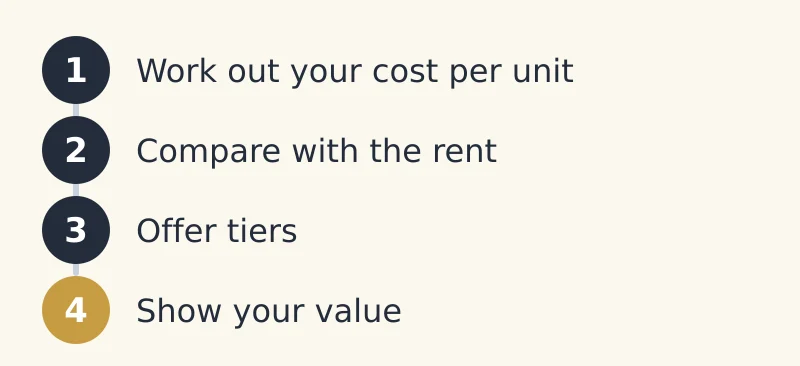
- Work out your cost per unit. Add staff time, transport, phone and office costs, and software. Divide by the number of units you manage.
- Compare with the rent. If your cost per bedsitter is close to 10% of its rent, a 7.5% fee loses money.
- Offer tiers. For example, rent collection only, or full management with repairs and utilities.
- Show your value. Landlords pay more willingly when they see low arrears, quick re-letting and clear statements.
The agencies that grow are usually the ones that can show landlords exactly where every shilling went.
Quick checklist before you agree a fee
- Get quotes from at least three agents
- Confirm the agent is registered with the EARB
- Ask whether fees are on rent collected or billed
- Ask whether quotes include VAT
- Ask for a sample monthly statement
- Agree a repair spending limit
- Read the exit terms
See ISHI in action
ISHI is property management software built for Kenyan landlords and agencies. It helps you track rent, arrears, repairs and landlord statements in one place, so your fees are easy to justify and easy to report.
Book a free demo at www.ishi.digital/contact, call 0116888777 or email hello@ishi.digital.
Questions people ask
How much do property managers charge in Kenya?
Many agencies charge a monthly management fee of about 5% to 10% of the rent, with 7.5% to 10% common for residential units. The exact rate depends on building size, rent level and what work is included.
What is a letting fee?
A letting fee is a one-off charge for finding a new tenant. In Kenya it is commonly between half and one full month's rent, but it is agreed between the landlord and the agent.
Should the management fee be on rent collected or rent billed?
For landlords, a fee on rent collected is usually better because you only pay when tenants actually pay. Make sure the contract states which one applies.
Is there an official fee scale for estate agents in Kenya?
Estate agents are regulated under the Estate Agents Act and must be registered with the Estate Agents Registration Board. Most fees are agreed in the market, so confirm with the agent or the Board whether any official guidance applies to your property.
Do landlords pay VAT on agency fees?
If the agency is registered for VAT, it may add VAT to its fees. Always ask whether a quoted fee includes VAT.
Keep reading

How to Start a Property Management Company in Kenya
A step-by-step guide to starting a property management company in Kenya. It covers registration, licences, pricing your services, handling client money and winning your first landlords.
25 October 2026 · 7 min read
Rent reminder messages that get paid: SMS and WhatsApp templates
Copy-and-paste rent reminder templates in English and Kiswahili for SMS and WhatsApp, from a friendly early nudge to a final arrears notice, plus a simple sending schedule.
25 October 2026 · 7 min read
Monthly rental income tax in Kenya: who pays, how much and how to file
A plain guide to monthly rental income tax in Kenya for landlords and agencies: who it covers, the current rate, worked examples using real rents, and how to file and pay on iTax.
25 October 2026 · 6 min read