
Bedsitters vs one bedrooms: which earns landlords more?
Bedsitters bring in more rent per square metre, but they empty out more often. We compare yield and vacancy using ISHI Homes rent data so you can choose the right unit mix for your plot.
If you are about to build or convert a rental block, one question decides a lot of your future income: do you fill the floor with bedsitters or with one bedroom units? This guide looks at bedsitter investment in Kenya against one bedrooms, using real ISHI Homes rents, and shows why the answer depends on vacancy as much as on rent.
What the rent data says
Here are the median monthly rents on ISHI Homes across all areas, as of 26 Oct 2026:

| Unit type | Median rent (KES) | Listings |
|---|---|---|
| Bedsitter | 8,500 | 8 |
| 1 bedroom apartment | 15,750 | 8 |
| 2 bedroom apartment | 28,000 | 10 |
A one bedroom earns a bit less than twice what a bedsitter earns. That gap matters, because a bedsitter usually takes much less floor space than a one bedroom. In many layouts, the space of one one bedroom can hold roughly two bedsitters. If that holds on your plot, two bedsitters bring in KES 17,000 against KES 15,750 for the one bedroom.
On paper, bedsitters win. But rent on paper is not rent in your account.
Bedsitter investment in Kenya: the area picture
The gap changes from area to area. These are ISHI Homes medians as of 26 Oct 2026. Some rest on only one or two listings, so treat them as a starting point, not a rule.

| Area | Bedsitter (KES) | 1 bedroom (KES) | Two bedsitters vs one 1 bedroom |
|---|---|---|---|
| Kahawa Wendani | 8,500 | 13,250 | 17,000 vs 13,250 |
| Kahawa Sukari | 10,000 | 15,750 | 20,000 vs 15,750 |
| Toll (Ruiru) | 7,750 | 12,500 | 15,500 vs 12,500 |
| Roysambu | 12,000 | 18,250 | 24,000 vs 18,250 |
In every one of these areas, two bedsitters out-earn one one bedroom on rent alone. Kahawa Wendani shows the widest gap in proportion. That fits what landlords there often say: a lot of single tenants, many of them students, want a cheap room close to where they study or work.
Vacancy: the cost that hides in the numbers
Vacancy is the time a unit sits empty with no rent coming in. It is where bedsitters give back some of their advantage.
Bedsitter tenants tend to be:
- Students who leave at the end of a course or for long holidays
- Young workers who move when they get a raise or a new job
- People who upgrade to a one bedroom as soon as they can
One bedroom tenants are more often couples or settled workers. They move less, because moving a household is costly and tiring.
Each move-out costs you more than the lost month. There is repainting, small repairs, the caretaker's time showing the unit, adverts and sometimes an agent's fee.
A worked example
Take the same floor space and two choices. The vacancy figures below are examples to show the method, not measured data. Use your own numbers.
Option A: two bedsitters at KES 8,500 each
- Full-year rent: 2 x 8,500 x 12 = KES 204,000
- Say each unit sits empty 1.5 months a year: 3 empty unit-months x 8,500 = KES 25,500 lost
- Rent collected: KES 178,500
Option B: one one bedroom at KES 15,750
- Full-year rent: 15,750 x 12 = KES 189,000
- Say it sits empty 0.75 months a year: about KES 11,800 lost
- Rent collected: about KES 177,200
The two options now earn almost the same. And Option A still has more turnover costs: two units to repaint, two sets of keys, two meters, and twice the chances of arrears.
The lesson is simple. Bedsitters only win clearly when demand is strong enough to refill them fast.
Running costs per unit
More doors means more of everything:
- Plumbing and fittings. Every bedsitter needs its own toilet, shower and kitchen point. That costs more at build time and more to maintain.
- Meters. Separate KPLC token meters and water meters for each unit add cost but save fights over bills.
- Collection work. Twenty bedsitter tenants means twenty payments to track each month, against ten for one bedrooms in the same space.
- Arrears risk. Tenants on tight budgets are more likely to pay late or in parts.
None of these is a reason to avoid bedsitters. They are reasons to price them properly and run them tightly.
How to calculate yield the honest way
Yield tells you what the building earns compared with what it cost. Use this:
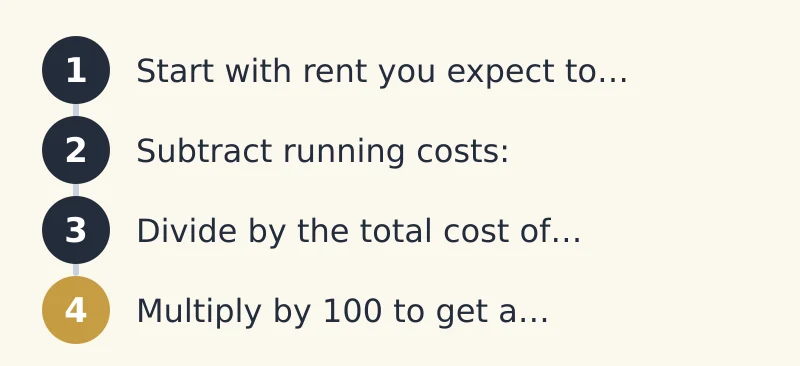
- Start with rent you expect to collect in a year, after empty months.
- Subtract running costs: caretaker, repairs, security, water for common areas, management fees, and the tax you owe on the rent.
- Divide by the total cost of building or buying.
- Multiply by 100 to get a percentage.
Run it twice, once for each unit mix. The option with the higher yield after vacancy and costs is the one that earns more. Not the one with the higher rent per room.
When bedsitters make sense
Bedsitters tend to work well when:
- You are near a university, college, industrial area or busy stage where single tenants gather
- Plenty of similar bedsitters nearby are full, not standing empty
- You or your caretaker can refill units quickly
- You collect rent through a system that tracks many small payments without errors
When one bedrooms make sense
One bedrooms tend to work better when:
- The area draws couples, young families and settled workers
- You want fewer tenants and less day-to-day work
- You prefer steady income over the highest possible rent per square metre
- Many bedsitters nearby already sit empty
The middle path: a mix
Many successful blocks mix unit types. A common pattern is bedsitters on some floors and one or two bedrooms on others. This spreads your risk. If students leave in a slow month, your longer-staying one bedroom tenants keep income steady.
Before you decide, walk the area. Count "To Let" signs on bedsitter blocks and on one bedroom blocks. Ask caretakers how fast units fill. Check ISHI Homes for what similar units are listed at today. That local evidence beats any national average.
See ISHI in action
Whatever mix you choose, more units means more rent to track. ISHI is property management software for Kenyan landlords and agencies. It handles M-Pesa rent collection, invoices and reminders, tenant and owner portals, maintenance and reports, so a block full of bedsitters is no harder to run than a few big units.
Book a free demo at www.ishi.digital/contact, call 0116888777 or email hello@ishi.digital.
Questions people ask
Is a bedsitter a good investment in Kenya?
It can be, especially near universities, industrial areas and busy transport routes where single tenants look for cheap rooms. Bedsitters often earn more rent for the same floor space, but you must plan for more frequent move-outs.
Do bedsitters or one bedrooms have more vacancy?
Bedsitter tenants tend to move more often, because many are students or young workers whose plans change quickly. One bedroom tenants, often couples, usually stay longer, so each unit sits empty less.
How do I calculate rental yield?
Take the rent you actually collect in a year, subtract running costs, and divide by what the building cost you. Multiply by 100 for a percentage. Use collected rent, not the full asking rent, so empty months are counted.
Should I build only bedsitters or mix unit types?
A mix often works best. Bedsitters lift income per floor, while one and two bedrooms bring steadier, longer-staying tenants. Let local demand decide the ratio.
What is the median bedsitter rent on ISHI Homes?
As of 26 Oct 2026, the median bedsitter rent across ISHI Homes listings was KES 8,500 a month, against KES 15,750 for a one bedroom apartment.
Keep reading

Where to build rentals around Nairobi: best areas ranked by demand and land cost
Thinking of building rental units? A ranked look at areas around Nairobi using ISHI Homes rent data, with the land-cost trade-offs, the unit types tenants want and the checks to do before you buy a plot.
9 November 2026 · 6 min read
Is buy-to-let still worth it in Nairobi? Yields, vacancy and hidden costs
A plain guide for landlords on whether buy-to-let in Nairobi still pays: how to work out real yield, what an empty month costs you, and the costs most people forget.
1 November 2026 · 6 min read
Rental yield in Kenya: how to calculate gross and net yield
A simple guide for landlords and agencies on calculating rental yield in Kenya, with worked gross and net yield examples using ISHI Homes rent data.
25 October 2026 · 6 min read