
Tenant screening in Kenya: checks that do not scare good tenants away
A practical guide for Kenyan landlords and agencies on fair, quick tenant screening that protects your rent and respects the Data Protection Act.

Every landlord wants a tenant who pays on time and looks after the house. But tenant screening in Kenya often goes too far: long forms, six months of payslips, ID photocopies kept on WhatsApp, and questions that have nothing to do with rent. Good tenants have choices, and they walk away. Their personal data is also protected by law.
This guide shows you which checks are worth doing, which ones to drop, and how to handle tenant information safely.
Why lighter screening often works better
The best applicants are usually busy people with steady income and other options. If your process is slow or feels intrusive, they take the next house they see. You are left with applicants who had nowhere else to go.

Proportionate screening means checking only what you need to answer two questions:
- Can this person afford the rent?
- Will they look after the property and keep to the lease?
Anything that does not help answer these questions adds risk for you and friction for the tenant.
What the Data Protection Act means for landlords
Kenya's Data Protection Act, 2019 covers personal data such as ID numbers, phone numbers, payslips, bank or M-Pesa statements and references. When you collect this from an applicant, you are handling personal data and the law applies to you.

In plain terms, the main principles are:
- Have a clear reason. Collect data only for screening and managing the tenancy.
- Collect the minimum. This is called data minimisation: take only what you need, nothing extra.
- Tell people. Let applicants know what you collect, why, who will see it and how long you keep it.
- Keep it safe. Store documents securely, not in open WhatsApp chats or shared phones.
- Do not keep it forever. Delete what you no longer need.
- Respect their rights. People can ask to see the data you hold about them and ask you to correct or delete it.
The law treats some data as sensitive, for example ethnicity, religion, health, marital status and family details. Do not ask for these when screening. They do not tell you whether someone will pay rent, and asking can also look like discrimination.
Some landlords and agencies may need to register with the Office of the Data Protection Commissioner (ODPC), the government body that enforces the Act. Whether you must register depends on your size and activities, so check the current rules on the ODPC website or with an adviser.
The checks worth doing
You can screen most applicants well with four simple checks.
1. Identity
Confirm the person is who they say they are.
- Look at the original national ID or passport in person or on a video call.
- Record the name and ID number for the lease.
- Only keep a copy if you truly need one, and store it securely.
2. Ability to pay
Ask for one proof of income, and let the applicant choose:
- A recent payslip or employment letter
- A bank statement or M-Pesa statement covering a few recent months
- For business owners: recent business statements or proof of regular income
Tell applicants they can cover up (redact) transactions that are not relevant. You need to see regular income, not who they send money to.
3. A previous landlord reference
This is often the most useful check. Ask the previous landlord or caretaker short questions:
- Did they pay rent on time?
- Did they leave the house in good condition?
- Would you rent to them again?
Get the applicant's consent before you call, and do not share their details beyond what is needed.
4. A short conversation
A quick chat tells you a lot. Ask when they want to move in, how many people will live there and whether they have any questions about the lease. Keep it friendly. You are also selling the house.
A simple affordability guide
A common rule of thumb is that rent should be about a third of a household's monthly income. Treat it as a guide, not a hard rule. Many Nairobi households pay more and still pay reliably, and some share rent with a partner or relative.
Here is what that looks like using ISHI Homes listings across all areas, as of 25 Oct 2026:
| Unit type | Median rent | Typical rent plus deposit | Income at one third rent |
|---|---|---|---|
| Bedsitter | KES 8,500 | KES 17,000 | about KES 25,500 |
| 1 bedroom apartment | KES 15,750 | KES 31,500 | about KES 47,250 |
| 2 bedroom apartment | KES 28,000 | KES 56,000 | about KES 84,000 |
| 3 bedroom house | KES 45,000 | KES 90,000 | about KES 135,000 |
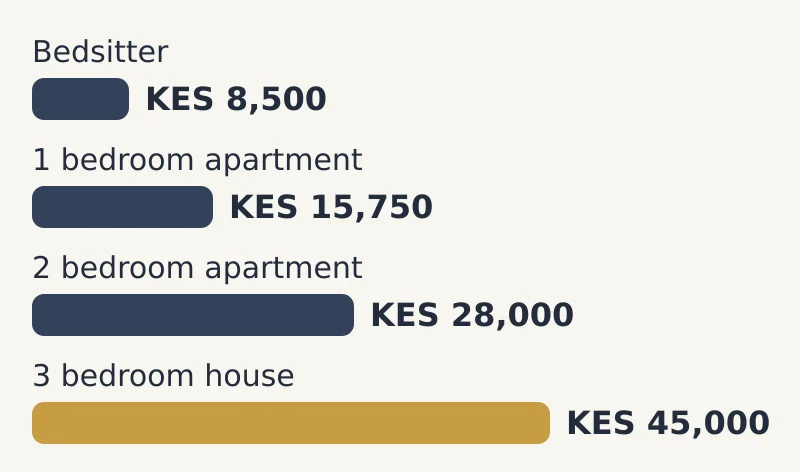
Remember the move-in cost, which is rent plus deposit paid upfront. An applicant who can pay KES 56,000 to move into a 2 bedroom apartment has already shown they can manage money. Do not ask for more proof than the rent level needs.
Checks to drop or handle with care
| Practice | Why to avoid it | Better option |
|---|---|---|
| Asking for six or more payslips | Slow and intrusive | One recent proof of income |
| Questions on tribe, religion or marital status | Sensitive data, may be discriminatory | Ask only how many people will live there |
| Keeping ID copies in WhatsApp chats | Easy to leak or misuse | Secure storage with limited access |
| Checking personal social media | Not relevant to rent, can be unfair | Use a landlord reference |
| Sharing "bad tenant" lists in groups | Can breach data protection law and harm reputations | Rely on direct references with consent |
| Credit bureau (CRB) checks without consent | May not be lawful | Ask clearly for written consent first, or skip it |
| Non-refundable "application fees" | Puts good applicants off | Keep screening free |
A screening process tenants will not mind
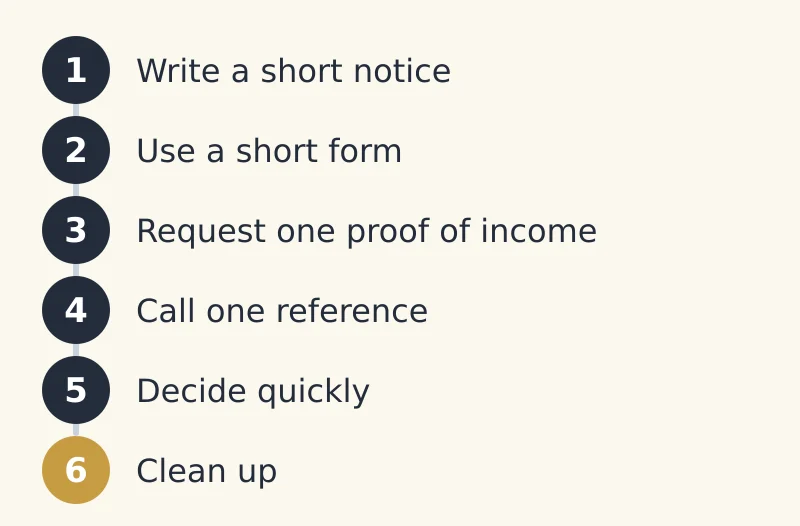
- Write a short notice. One paragraph explaining what you collect, why, who sees it and when you delete it.
- Use a short form. Name, phone, ID number, move-in date, number of occupants, current landlord contact.
- Request one proof of income. Let the applicant choose the type.
- Call one reference. With consent.
- Decide quickly. Good applicants will not wait long. Reply even if the answer is no.
- Clean up. Delete documents from applicants you did not choose once you no longer need them. For the chosen tenant, keep only what the tenancy needs.
Saying no politely
If you turn someone down, tell them clearly and kindly. If they ask why, give an honest, simple reason, for example that the income did not match the rent. Never mention personal traits. A respectful "no" protects your reputation, and that applicant may suit another of your units later.
Keep tenant data safe after move-in
Screening is only the start. During the tenancy you will hold phone numbers, payment records and the lease. Keep these in one secure place, limit who can see them, and update or delete records when the tenant moves out and any deposit matters are settled.
See ISHI in action
ISHI property management software helps landlords and agencies keep applicant and tenant records in one secure place, track rent and manage vacancies without messy spreadsheets or WhatsApp threads. Book a free demo at www.ishi.digital/contact, call 0116888777 or email hello@ishi.digital.
Questions people ask
Is tenant screening legal in Kenya?
Yes. Landlords can check identity, income and references, but the Data Protection Act, 2019 requires you to collect only what you need, tell applicants why and keep the data safe.
Can I ask a tenant for an M-Pesa statement?
You can ask for it as one option for proving income. Let the applicant choose between a payslip, bank statement or M-Pesa statement, and allow them to cover unrelated transactions.
How much should a tenant earn to rent my house?
A common rule of thumb is rent of about a third of monthly household income. Use it as a guide, since many reliable tenants pay more or share rent with others.
Can I do a CRB check on a prospective tenant?
Only with the applicant's clear, written consent and through a licensed credit reference bureau. For most rentals, a previous landlord reference is enough.
How long should I keep documents from applicants I rejected?
Only as long as you need them. Set a short, fixed period, tell applicants about it and delete the documents securely afterwards.
Do landlords need to register with the Data Protection Commissioner?
It depends on your size and activities. Check the current registration rules on the ODPC website or ask an adviser.
Keep reading

How to Fill a Vacant House Faster: A Simple Guide for Landlords
Every empty month costs you a full month of rent. Here is how Kenyan landlords and agencies can fill a vacancy fast with the right price, good photos, a clear listing and quick replies to viewing requests.
25 October 2026 · 7 min read
Property management fees in Kenya: what agencies charge
A plain guide to property management fees in Kenya: common ranges for management and letting fees, the extra charges to watch for, and how to work out what a fair deal looks like for your building.
25 October 2026 · 7 min read
Rent reminder messages that get paid: SMS and WhatsApp templates
Copy-and-paste rent reminder templates in English and Kiswahili for SMS and WhatsApp, from a friendly early nudge to a final arrears notice, plus a simple sending schedule.
25 October 2026 · 7 min read