
Tenant not paying rent in Kenya: a lawful step-by-step process
A plain guide for Kenyan landlords and agencies on handling rent arrears the legal way: records, talking, payment plans, demand letters, notices, tribunals and courts, without self-help eviction.

A tenant not paying rent in Kenya is one of the most stressful problems a landlord or agency can face. The bills, loan repayments and service charges still need paying. But how you respond matters. Act within the law and you can recover your money or your house. Act outside it and you may end up paying the tenant instead.
This guide walks you through a lawful process, from the first missed payment to a court or tribunal order.
First, what not to do: self-help eviction
"Self-help eviction" means forcing a tenant out yourself, without an order from a court or tribunal. It includes:

- Changing the locks or padlocking the door
- Removing doors, windows or the roof
- Cutting off water or electricity
- Taking the tenant's goods without a lawful process
- Sending people to threaten or throw the tenant out
These actions are generally unlawful in Kenya. A tenant can go to court, get an order to be let back in, and claim damages (money paid as compensation). In some cases it can also lead to criminal charges. Even when the tenant owes you a lot, self-help usually makes your position weaker, not stronger.
Step 1: Check your records and the lease
Before you contact the tenant, be sure of the facts.

- How much is owed? List each month, the amount due and what was paid.
- Proof of payment. Collect M-Pesa statements, bank records and receipts.
- The lease (tenancy agreement). Check the rent due date, any late payment terms, the notice period and how notices must be delivered.
- The deposit. Note how much you hold and what the lease says about using it.
Clear records are your strongest tool later if the matter goes to a tribunal or court.
Step 2: Talk to the tenant early
Most arrears start with a real problem: a lost job, a late salary, a family emergency. A quick, calm conversation in the first week often solves more than a lawyer can months later.
- Call or visit politely and ask what has happened.
- Listen. Find out if the problem is short-term or long-term.
- Ask when they can realistically pay.
- Follow up the call with a short SMS or email confirming what was said.
The longer arrears run, the harder they are to recover. As a guide, ISHI Homes listings as of 25 Oct 2026 show a median rent of KES 15,750 a month for a 1 bedroom apartment. Three missed months on a unit like that is already KES 47,250, more than a typical deposit covers.
Step 3: Agree a payment plan in writing
If the tenant wants to stay and can pay over time, a payment plan can work for both of you.
A good plan states:
- The total arrears
- The amount and date of each instalment
- That current rent must still be paid on time
- What happens if a payment is missed (for example, you will move to formal notice)
Have both sides sign and date it, and keep a copy. A signed plan is also evidence that the tenant admits the debt.
Step 4: Send a formal demand letter
If talking does not work, or the tenant breaks the plan, send a written demand letter. This is a formal request to pay by a set date.
Include:
- Tenant's name and the house number
- A clear statement of arrears, month by month
- The deadline to pay (for example, 7 or 14 days)
- How to pay
- That you may take legal action if they do not pay
Deliver it in the way the lease requires and keep proof, such as a signed acknowledgement, a photo of delivery or a courier receipt. Many landlords ask a lawyer to send this letter because it often gets a faster response.
Step 5: Give proper notice to end the tenancy
If you want the tenant to leave, you must end the tenancy properly before going further.
- Follow the lease. Use the notice period it sets.
- No written lease? A month-to-month tenancy usually needs at least one full month's notice. Confirm the right period with a lawyer.
- Put it in writing. State the date the tenancy ends and the reason (rent arrears).
- Keep proof of delivery.
Some tenancies have special rules. Certain business premises and some low-rent homes are "controlled tenancies", where a set legal notice form and process apply. Using the wrong notice can make it invalid, so check which rules apply to your property.
Step 6: Use the deposit correctly
The deposit is security for rent and damage. It is not a reason to skip the legal process.
- Check what the lease allows. Many leases say the deposit is for the end of the tenancy, not for current rent.
- After the tenant leaves, deduct genuine arrears and repair costs.
- Give the tenant a written breakdown and return any balance.
Step 7: Take the matter to the right forum
If the tenant still does not pay or leave, you need an order. Where you go depends on the type of tenancy.
| Type of tenancy | Where landlords usually go |
|---|---|
| Most residential homes | Magistrates' court (or Small Claims Court for smaller money claims) |
| Low-rent homes covered by rent control law | Rent Restriction Tribunal |
| Controlled business premises (shops, hotels, some offices) | Business Premises Rent Tribunal |
You can ask for one or more of:
- Payment of arrears
- Vacant possession (an order that the tenant leaves)
- Costs and interest
Bring your lease, payment records, letters, notices and proof of delivery. A lawyer can advise on the forum, filing fees and how long it may take.
Step 8: Enforce the order lawfully
Winning an order is not the end. Enforcement must also follow the law.
- Eviction is carried out under the order, usually by a licensed court broker or auctioneer, sometimes with police present to keep peace.
- Recovering money may involve attaching the tenant's goods through a licensed auctioneer acting on proper instructions or a court warrant.
- Distress for rent (seizing goods to cover arrears) has its own legal rules. Do not try it yourself. Use a licensed auctioneer and get legal advice first.
How to prevent arrears in the first place
- Screen tenants. Ask for references, ID and proof of income.
- Use a clear written lease. State the due date, late terms, notice period and deposit rules.
- Send reminders. A friendly reminder before the due date reduces late payments.
- Act fast. Follow up on day one of a missed payment, not month three.
- Keep tidy records. Track every payment and every message in one place.
Quick checklist
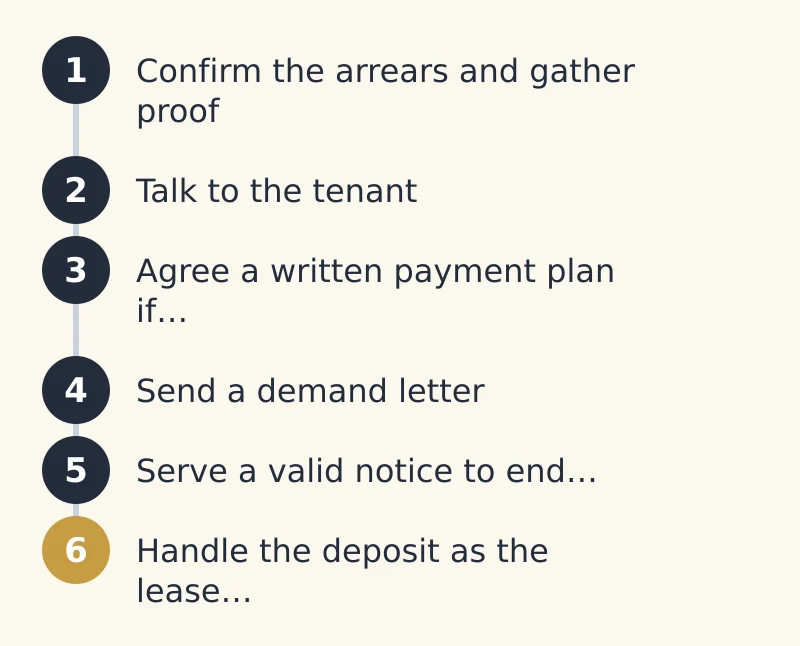
- Confirm the arrears and gather proof
- Talk to the tenant
- Agree a written payment plan if possible
- Send a demand letter
- Serve a valid notice to end the tenancy
- Handle the deposit as the lease allows
- File at the right court or tribunal
- Enforce the order through licensed officers only
See ISHI in action
Chasing rent is easier when your records, reminders and tenant messages are organised. ISHI is property management software built for Kenyan landlords and agencies. Book a free demo at www.ishi.digital/contact, call 0116888777 or email hello@ishi.digital to see how it can help you stay on top of rent collection.
Questions people ask
Can I lock out a tenant who is not paying rent in Kenya?
No. Locking out a tenant, removing doors or cutting water and power without a court or tribunal order is self-help eviction and is generally unlawful. The tenant can sue for damages and be allowed back in.
How much notice must I give a tenant to leave for rent arrears?
Follow the notice period in your lease. For a month-to-month tenancy without a written lease, at least one full month is common, but controlled tenancies have special forms and rules, so check with a lawyer.
Can I use the deposit to cover unpaid rent?
It depends on your lease. Many leases treat the deposit as security for the end of the tenancy, so deduct arrears and repairs after the tenant leaves and give a written breakdown.
Where do I file a case against a tenant who will not pay?
Most residential cases go to the magistrates' court, while smaller money claims may go to the Small Claims Court. Some low-rent homes go to the Rent Restriction Tribunal and some business premises to the Business Premises Rent Tribunal.
Can I take a tenant's goods to recover rent?
Not by yourself. Seizing goods for rent (distress) must follow the law and be done by a licensed auctioneer with proper instructions or a court warrant, so get legal advice first.
Is a payment plan legally binding?
A written, signed payment plan is good evidence that the tenant owes the money and agreed to pay it. If the tenant breaks it, you can move on to formal notice and legal action.
Keep reading

Rent reminder messages that get paid: SMS and WhatsApp templates
Copy-and-paste rent reminder templates in English and Kiswahili for SMS and WhatsApp, from a friendly early nudge to a final arrears notice, plus a simple sending schedule.
25 October 2026 · 7 min read
How to reduce rent arrears: a 30-day process that works
A simple 30-day plan for Kenyan landlords and agencies to reduce rent arrears, with a reminder schedule, clear escalation steps and ready-to-use SMS and call scripts.
25 October 2026 · 8 min read
How to collect rent on M-Pesa without manual reconciliation
A step-by-step guide for Kenyan landlords and agencies: set up a Paybill, design account numbers tenants get right, and let payments match to units automatically so you stop checking statements by hand.
25 October 2026 · 7 min read