
How to scale property management from 50 to 500 units without doubling staff
Growing from 50 to 500 units breaks the notebook-and-WhatsApp way of working. The process and software changes that let Kenyan agencies scale property management without hiring at the same pace.

At 50 units, you know every tenant by name. You remember who pays late, which caretaker is reliable and which landlord wants his statement on the 5th. At 500 units, that memory becomes a liability. To scale property management without doubling staff, you have to change how the work is done, not just how many people do it.
Why staff costs grow with units
In most agencies, staff time is spent on the same few tasks, repeated for every unit, every month:

- Checking M-Pesa and bank statements to see who paid
- Sending reminders by SMS and WhatsApp, one by one
- Answering "how much do I owe?" calls
- Preparing statements for each landlord
- Chasing repairs between tenants, caretakers and fundis
When every one of those tasks is manual, ten times the units means roughly ten times the work. The goal is to break that link.
Lever 1: Write down your processes
At 50 units, each staff member can do things their own way. At 500, that creates chaos. Write a short, clear process for each routine task:
- New tenant move-in
- Monthly rent collection and follow-up
- Arrears escalation
- Maintenance request to job closed
- Tenant move-out and deposit refund
- Monthly owner reporting
Keep each one to a page. Say who does what, by when, and what "done" looks like. New staff learn faster, and work no longer depends on one person being in the office.
Lever 2: Standardise unit and tenant codes
Every unit needs one unique, simple code used everywhere: in the lease, the Paybill account number, invoices and reports. For example, a short property code plus the unit number.

This sounds small. It is the base for everything else. Without consistent codes, no system can match payments or produce clean reports.
Lever 3: Automate rent collection and matching
Matching rent payments to tenants by hand is often the biggest single drain on staff time. Set up:
- One Paybill for rent, with each tenant using their unit code as the account number
- Software that receives payment notifications and matches them to the right unit
- A short list of unmatched payments for a person to sort
Staff then stop checking every payment and start checking only the exceptions.
Lever 4: Let invoices and reminders send themselves
Rent invoices go out on the same day each month. Reminders follow a set pattern: before the due date, on it, and after it. There is no reason for a person to send each one by hand.
Automated, consistent reminders also tend to improve on-time payment, because every tenant hears the same thing at the same time.
Lever 5: Give tenants and owners self-service
Every phone call that says "what is my balance?" or "has rent come in?" takes staff time. Portals answer those questions without a call:
- Tenants can see their balance, receipts and lease, and log repair requests.
- Owners can see rent collected, arrears and statements for their properties.
Owners who can see their numbers whenever they like call less often and trust you more.
Lever 6: Manage by exception
At scale, staff should not look at everything. They should look at what needs attention. Set up simple daily or weekly lists:
- Unmatched payments
- Tenants more than a set number of days in arrears
- Units vacant for more than a set number of weeks
- Maintenance jobs open longer than your target
If a list is empty, nothing needs doing. Staff time goes where it matters.
Lever 7: Organise maintenance
Repairs are hard to scale through phone calls. Instead:
- Log every request in one place, with the unit, issue and date
- Assign each job to a caretaker or fundi with a target date
- Record cost and completion
- Report open jobs to owners
This turns maintenance from a stream of calls into a list you can manage.
Lever 8: Build the team around roles
As you grow, give people clear roles rather than "everyone does everything":
| Role | Main focus |
|---|---|
| Collections | Arrears follow-up and payment plans |
| Tenant relations | Move-ins, move-outs, complaints |
| Maintenance coordinator | Repairs, caretakers and fundis |
| Owner relations | Statements, reports and owner questions |
| Finance | Reconciliation, remittances to owners, audit |
At 50 units one person may hold several roles. At 500, clear roles stop work falling between people.
Track the numbers that matter
Watch a few figures every month:
- Rent collected as a share of rent due
- Arrears by age: under 30 days, 30 to 60, over 60
- Vacant units and days empty
- Open maintenance jobs and average days to close
- Units per staff member
The last one tells you whether your levers are working. If it rises while collection and tenant satisfaction hold steady, you are scaling well.
A sensible order to make changes
- Fix unit codes and the Paybill set-up
- Move all records into one system
- Automate collection, invoices and reminders
- Open tenant and owner portals
- Write processes and set exception lists
- Shape roles as the team grows
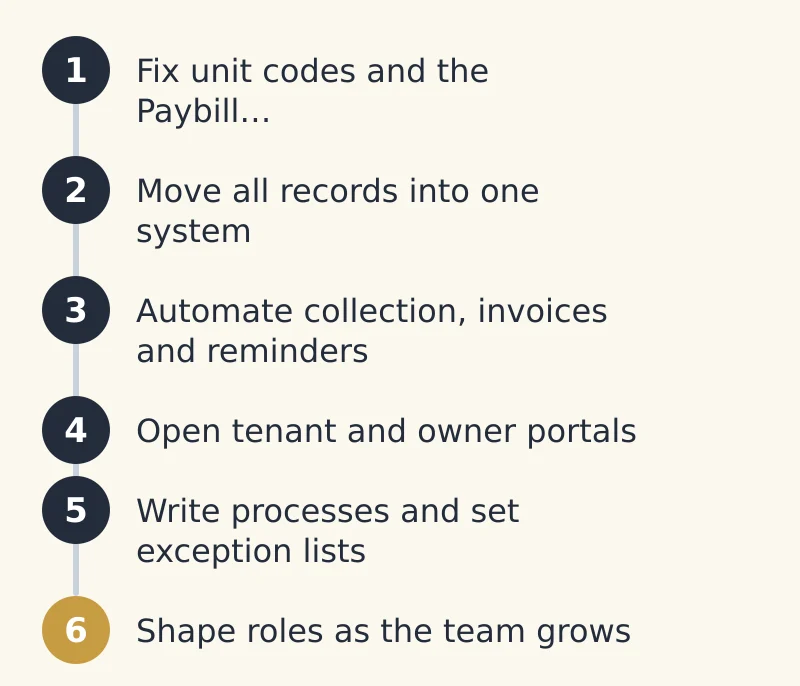
Do not try everything in one month. Each step frees time for the next.
See ISHI in action
ISHI is property management software built for Kenyan landlords and agencies. It brings M-Pesa rent collection, invoices and reminders, tenant and owner portals, maintenance and reports into one place, so your team spends its time on exceptions, not routine.
Book a free demo at www.ishi.digital/contact, call 0116888777 or email hello@ishi.digital.
Questions people ask
How many units can one property manager handle?
It depends heavily on systems. With manual records, one person may struggle with a few dozen units. With standard processes and good software, the same person can handle many more.
What should a property agency automate first?
Start with rent collection and matching, because it takes the most hours each month. Then automate invoices, reminders and owner statements.
How do I stop staff time growing as I add units?
Standardise every routine task, let tenants and owners serve themselves through portals, and manage by exception, so staff only touch the payments and requests that need a person.
Do I need different processes for 500 units?
You need the same processes written down and followed by everyone. At 50 units you can rely on memory. At 500, anything not written down gets done differently by each person.
What reports should an agency watch as it grows?
Watch rent collected against rent due, arrears by age, vacant units and how long they have been empty, and open maintenance jobs.
Keep reading

Property management agreement in Kenya: the key clauses, with a checklist
The agreement between a landlord and a managing agent decides who does what, who holds the money and how either side can walk away. The key clauses to include, in a checklist.
15 November 2026 · 5 min read
Owner statements landlords actually understand: a template with explanations
A clear owner statement template for Kenyan agencies, line by line. What to include, how to show rent, arrears, commission and expenses, and the habits that stop landlord phone calls at month-end.
8 November 2026 · 5 min read
How to Get Landlord Clients: Channels and a Pitch That Works
A practical guide for Kenyan property agencies on where to find landlords, what to say to them, and how to turn a first meeting into a signed management deal.
30 October 2026 · 7 min read