
Owner statements landlords actually understand: a template with explanations
A clear owner statement template for Kenyan agencies, line by line. What to include, how to show rent, arrears, commission and expenses, and the habits that stop landlord phone calls at month-end.

The landlord calls on the 10th. "You collected rent, so why did I only get this much?" The answer is somewhere in your spreadsheet, but the statement you sent did not make it obvious. A good owner statement answers that question before it is asked.
This guide gives you an owner statement template that Kenyan landlords can read in two minutes, and explains each part.
What landlords want to know
Most landlords look for four things, in this order:
- How much did I get? The payout.
- Why that much? Rent collected, minus fees and expenses.
- Who has not paid? Arrears by unit.
- What did you spend my money on? Repairs and other costs.
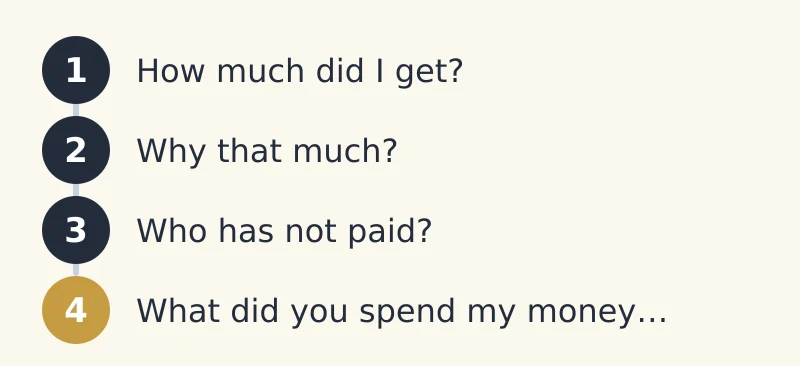
Your statement should answer these in that order. Put the payout at the top, not hidden at the bottom of page two.
The owner statement template
Here is a one-page layout. Copy it and adjust the labels to your agency. All names and amounts in it are for example only, to show how the lines add up; your own figures come from your rent records and suppliers' receipts.

Part 1: Summary
| Item | Amount |
|---|---|
| Opening balance | KES 0 |
| Rent collected | KES 63,750 |
| Less commission (10%) | KES 6,375 |
| Less expenses | KES 6,500 |
| Paid to you | KES 50,875 |
| Closing balance | KES 0 |
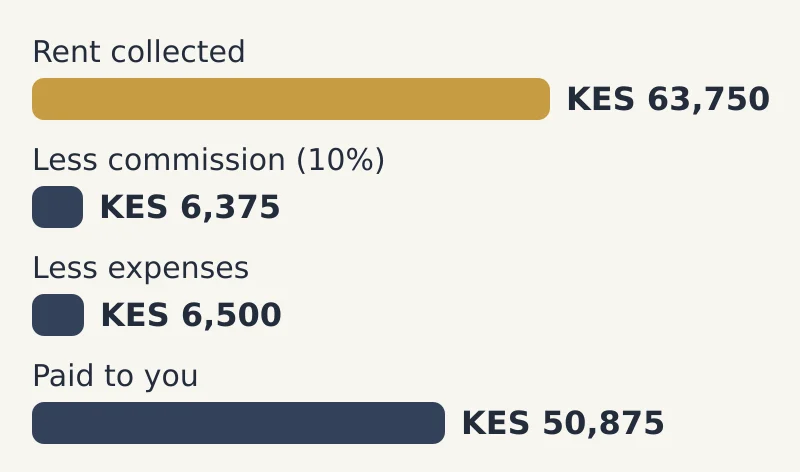
Payout = rent collected minus commission minus expenses. The example figures match the unit and expense tables below.
Part 2: Rent by unit
| Unit | Tenant | Rent due | Collected | Balance |
|---|---|---|---|---|
| A1 | J. Mwangi | KES 28,000 | KES 28,000 | KES 0 |
| A2 | P. Otieno | KES 28,000 | KES 20,000 | KES 8,000 |
| A3 | Vacant | - | - | - |
| B1 | M. Achieng | KES 15,750 | KES 15,750 | KES 0 |
Part 3: Expenses
| Date | Description | Paid to | Amount | Receipt |
|---|---|---|---|---|
| 6 Nov | Fix leaking pipe, A2 | Plumber | KES 3,500 | Attached |
| 12 Nov | Gutter cleaning | Fundi | KES 3,000 | Attached |
Part 4: Notes
A few lines of plain words: "A2 has agreed to clear KES 8,000 by 15 December. A3 is advertised; two viewings booked. Roof inspection planned before the next rains."
Each line, explained
Period and property
Start with the landlord's name, the property name and the period, such as "1 to 30 November 2026". If the landlord has more than one property, give each its own statement, or a clear section each.
Opening balance
What was owed to or by the landlord at the start of the month. Usually zero. It is not zero when last month's payout was held back, or when expenses were more than rent collected. Showing it stops "where did last month's money go?" calls.
Rent due and collected
Show both. Rent due tells the landlord what the building should earn. Rent collected tells them what came in. The gap is arrears, and the landlord should see it unit by unit.
If a tenant paid last month's arrears this month, show it as a separate line, for example "A2 arrears from October, KES 5,000". Mixing it into this month's rent confuses everyone.
Vacancies
List vacant units by name, with "Vacant" against them. A missing unit looks like hidden money. A listed vacancy, with a note on progress, looks like a manager at work.
Commission and fees
State the rule, then the figure: "Commission 10% of rent collected: KES 6,375." The rate in this example is for illustration; use what your management agreement says.
If you charge other fees, such as a letting fee for a new tenant, show each one separately with what it was for.
Expenses
Every shilling spent from the landlord's rent goes here, with:
- the date
- what was done, and where
- who was paid
- a receipt or invoice
Large or unexpected costs should never appear first on the statement. Call or message the landlord before you spend, and refer to that approval in the notes.
Payout
The amount sent to the landlord, the date and how, such as "Bank transfer, 5 December". If part of the payout is held back, say why, for example: "KES 10,000 held for roof repair approved on 28 November."
Closing balance
What is carried into next month. It becomes next month's opening balance, so the two statements join up.
Habits that build trust
- Same date every month. Pick a date, such as the 5th, and never miss it.
- Same layout every month. Landlords learn where to look.
- Separate landlord money from agency money. Rent belongs to the landlord until the payout. Keep it in a separate account if you can.
- Explain anything unusual in the notes, in one or two sentences.
- Make figures match. Rent collected on the statement should match what the tenant's receipts show. If it does not, find out why before sending.
- Keep statements for every month so a landlord can look back at any time.
Mistakes that cause calls
- Showing only the payout, with no breakdown
- Leaving out vacant units
- Commission charged on rent due when the agreement says collected
- Expenses with no receipt
- Different layouts from different staff
- Sending statements late, then all at once
From spreadsheet to system
A spreadsheet works for a few landlords. With more buildings, the same numbers get typed twice, once in rent records and once in statements, and that is where mistakes start. Property software can build statements straight from rent payments and recorded expenses, so the figures agree and the statement goes out on time.

See ISHI in action
ISHI is property management software for Kenyan landlords and agencies. It brings together M-Pesa rent collection, invoices and reminders, tenant and owner portals, maintenance and reports, so landlords see their money clearly and your team spends less time on calls.
Book a free demo at www.ishi.digital/contact, call 0116888777 or email hello@ishi.digital.
Questions people ask
What is an owner statement?
An owner statement is the monthly report an agency sends a landlord. It shows rent due and collected, arrears, the agency's fees, expenses paid for the property and the amount paid out to the landlord.
What should an owner statement include?
The period, the property, an opening balance, rent due and collected by unit, arrears, commission and fees, expenses with receipts, the payout and a closing balance.
Should commission be charged on rent due or rent collected?
It depends on your management agreement, but most landlords expect commission on rent actually collected. State the rule clearly in the agreement and on every statement.
How often should agencies send owner statements?
Monthly, on a fixed date, usually soon after rent is due and payouts are made. Landlords trust a statement that always arrives on the same day.
Should owner statements include receipts for repairs?
Yes. Attach or link a receipt or invoice for every expense, especially repairs. It is the quickest way to stop disputes about costs.
Keep reading

How to scale property management from 50 to 500 units without doubling staff
Growing from 50 to 500 units breaks the notebook-and-WhatsApp way of working. The process and software changes that let Kenyan agencies scale property management without hiring at the same pace.
24 November 2026 · 5 min read
Property management agreement in Kenya: the key clauses, with a checklist
The agreement between a landlord and a managing agent decides who does what, who holds the money and how either side can walk away. The key clauses to include, in a checklist.
15 November 2026 · 5 min read
How to Get Landlord Clients: Channels and a Pitch That Works
A practical guide for Kenyan property agencies on where to find landlords, what to say to them, and how to turn a first meeting into a signed management deal.
30 October 2026 · 7 min read