
VAT on commercial rent in Kenya: when it applies and how to invoice it
Letting shops, offices or godowns? When VAT on commercial rent applies in Kenya, how mixed buildings work, and how to set up invoices tenants and KRA will both accept.

Many landlords start with a few flats, then add a row of shops on the ground floor, and only later find out that the shops come with VAT. If you let shops, offices, warehouses or any space used for business, you need to know where you stand.
This guide explains when VAT on commercial rent in Kenya applies, how it works in mixed buildings, and how to invoice it properly. It is general guidance. Confirm your own position with a tax adviser or on KRA's website, because rates and rules change.
The basic rule
VAT (value added tax) is a tax on goods and services that a registered business adds to its prices and pays over to KRA.
For property, the position is:
- Residential rent is exempt. You do not charge VAT on houses and flats let as homes.
- Commercial rent is taxable. Shops, offices, godowns, kiosks, parking let to businesses and similar space are taxable supplies.
The standard VAT rate is currently 16%. Check KRA's website before you set up your invoices in case it has changed.
When you must register
You do not charge VAT just because you own a shop. You must register for VAT when your taxable supplies reach KRA's registration threshold in any 12 month period. At the time of writing, the threshold is KES 5 million.
Only taxable supplies count. Residential rent does not. So a landlord with large residential income and a small commercial block may be below the threshold, while a landlord with a few busy shops may be above it.
Points to watch:
- Track commercial rent separately from residential rent every month, so you see the 12 month total clearly.
- Register in time. If you cross the threshold, register promptly. Late registration can mean paying VAT you never collected from tenants.
- Voluntary registration may be possible below the threshold. Ask your adviser if it suits you, for example if your tenants are VAT-registered businesses that can claim the VAT back.
Mixed-use buildings
A block with shops below and flats above has two kinds of supply in one building.
- Charge VAT on the shop rents.
- Do not charge VAT on the flat rents.
- Split shared costs, such as security, cleaning and repairs, sensibly between the two. This matters if you claim back input VAT (the VAT you paid on costs), because you can generally only claim the part that relates to taxable supplies.
Keep a simple record of how you split shared costs and why. If KRA asks, you can explain it.
Service charge and other charges
Commercial tenants often pay more than base rent. Common extras include service charge, parking and signage. These are generally treated as part of the taxable supply, so VAT applies to them too. Utilities passed through at cost can be treated differently. Ask your adviser about each charge you bill.
How to invoice VAT on commercial rent
Once you are registered, every commercial rent invoice must be a proper tax invoice issued through KRA's electronic invoicing system (eTIMS) or another approved system. Your tenants need a valid invoice to claim the VAT you charge.

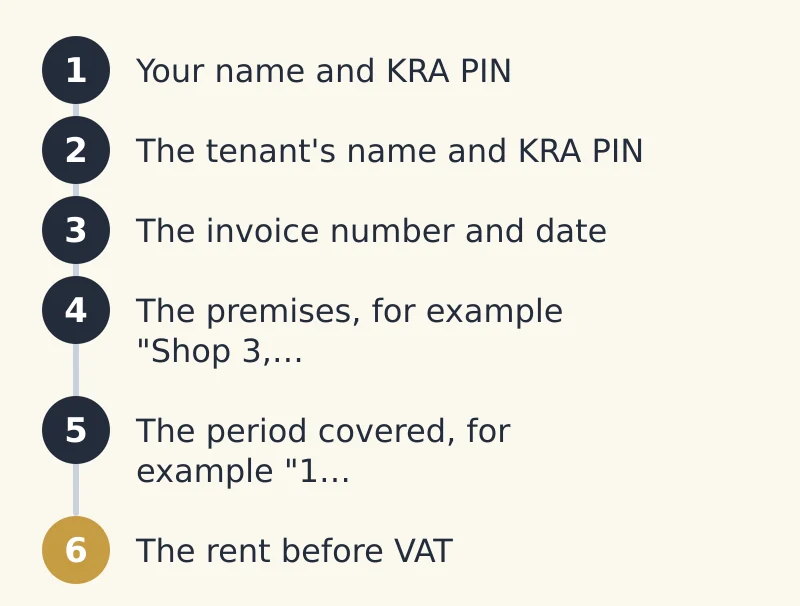
A good commercial rent invoice shows:
- Your name and KRA PIN
- The tenant's name and KRA PIN
- The invoice number and date
- The premises, for example "Shop 3, ground floor"
- The period covered, for example "1 to 30 November"
- The rent before VAT
- The VAT amount and rate
- The total due
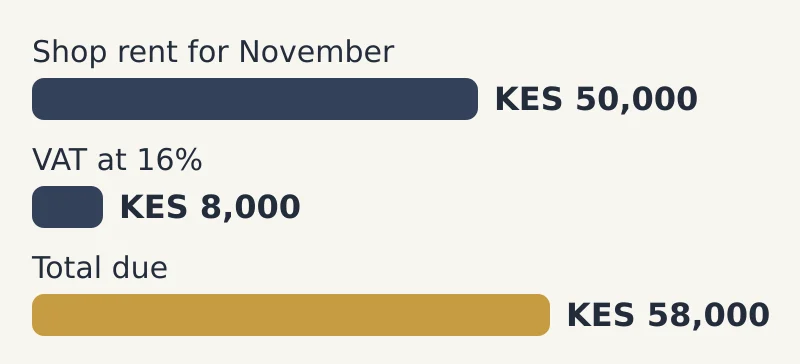
Here is a simple worked example, using an illustrative rent:
| Line | Amount |
|---|---|
| Shop rent for November | KES 50,000 |
| VAT at 16% | KES 8,000 |
| Total due | KES 58,000 |
Write the lease so the rent is stated exclusive of VAT ("rent of KES 50,000 plus VAT"). If the lease just says "KES 50,000", a tenant may argue that VAT is included, and you end up paying it out of your own rent.
Filing and paying

- File a VAT return every month, even in a month with no commercial income. At the time of writing, returns are due by the 20th of the following month.
- Pay what you collected from tenants, less any input VAT you can claim.
- Some tenants may withhold part of the VAT if KRA has appointed them as withholding VAT agents. They should give you a certificate, which you use when filing. Keep these certificates safe.
Common mistakes
- Charging VAT on residential rent. It is exempt.
- Leases that do not say "plus VAT".
- Invoices that do not go through eTIMS, so tenants cannot claim the VAT.
- Mixing commercial and residential income in one ledger, so no one knows when the threshold is crossed.
- Forgetting nil returns in quiet months.
See ISHI in action
ISHI is property management software for Kenyan landlords and agencies. It handles M-Pesa rent collection, invoices and reminders, tenant and owner portals, maintenance and reports, so your commercial and residential income stays clear and organised.
Book a free demo at www.ishi.digital/contact, call 0116888777 or email hello@ishi.digital.
Questions people ask
Is commercial rent subject to VAT in Kenya?
Yes. Letting commercial premises is a taxable supply, so a landlord registered for VAT must charge VAT on the rent. Residential letting is exempt.
When must a landlord register for VAT in Kenya?
When taxable supplies, including commercial rent, reach the registration threshold in a 12 month period. Check the current threshold on KRA's website.
Do I charge VAT on residential rent?
No. Letting of residential premises is exempt from VAT. Residential rent is taxed under income tax rules instead.
Is VAT charged on service charge for commercial tenants?
Service charge billed to commercial tenants is generally treated as part of the taxable supply. Confirm the treatment with your tax adviser.
What is eTIMS and do landlords need it?
eTIMS is KRA's electronic tax invoicing system. VAT-registered landlords need to issue invoices through an approved system so tenants can claim the VAT.
Keep reading

KRA's rental income tax regulations 2026: what changes for landlords
New rules on residential rental income tax are on the way. Here is how the current system works, what to look for in the 2026 regulations, and the records every landlord should keep now so any change is easy to handle.
20 November 2026 · 5 min read
eTIMS for landlords and property managers: what it means for rent and commission invoices
A plain guide to KRA's eTIMS for Kenyan landlords and agencies. Who needs to issue eTIMS invoices, how it touches rent, service charge and commission, and how to get your records ready.
4 November 2026 · 5 min read
How to file rental income tax on iTax, step by step
A simple, annotated walkthrough for landlords and agencies on how to file Monthly Rental Income tax on KRA iTax, pay it, and avoid penalties.
27 October 2026 · 6 min read