
Vacancy loss: what an empty house really costs you (with a calculator)
An empty unit costs more than missed rent. Use our simple vacancy cost calculator and worked examples with real ISHI Homes rents to see what each empty day costs you.

Every landlord knows an empty house earns nothing. Few landlords know the full figure. Your real vacancy cost as a landlord is the rent you lose, plus the bills you keep paying, plus the money you spend getting the unit ready again. This guide gives you a simple calculator and worked examples using real rents from ISHI Homes, so you can put a number on your own empty units.
Why vacancy loss is bigger than you think
When a tenant moves out, three kinds of cost start at once:

- Lost rent - the income you would have earned if the unit was occupied.
- Holding costs - bills you still pay while the unit is empty, such as security, water standing charges, electricity for common areas, service charge or loan repayments.
- Turnover costs - money spent to get the unit ready and find a new tenant, such as cleaning, painting, repairs, advertising and agent fees.
A note on deposits: a deposit is the tenant's money held as security against damage or unpaid rent. It is usually refundable, so do not count it as income that covers your vacancy.
The vacancy cost calculator
You only need a pen, or your phone calculator.

Step 1: Daily rent Daily rent = Monthly rent ÷ 30
Step 2: Lost rent Lost rent = Daily rent × Days empty
Step 3: Holding costs Add up what you pay each month on the empty unit, then divide by 30 and multiply by days empty.
Step 4: Turnover costs Add cleaning, painting, repairs, marketing and any agent fee.
Total vacancy cost = Lost rent + Holding costs + Turnover costs
To see how much of your year this eats up:
Share of yearly rent lost = Total vacancy cost ÷ (Monthly rent × 12)
The holding and turnover amounts in the examples below are made up to show the method. Use your own figures.
Worked example 1: a bedsitter in Kahawa Wendani
On ISHI Homes, the median rent for a bedsitter in Kahawa Wendani is KES 8,500 a month, as of 26 Oct 2026. (The median is the middle figure when all rents are lined up from lowest to highest.)
Say the unit stays empty for 45 days.
| Item | Working | Amount |
|---|---|---|
| Daily rent | 8,500 ÷ 30 | KES 283 |
| Lost rent | 283 × 45 days | KES 12,750 |
| Holding costs | example | KES 1,500 |
| Turnover costs | cleaning and touch-up paint, example | KES 6,000 |
| Total | KES 20,250 |
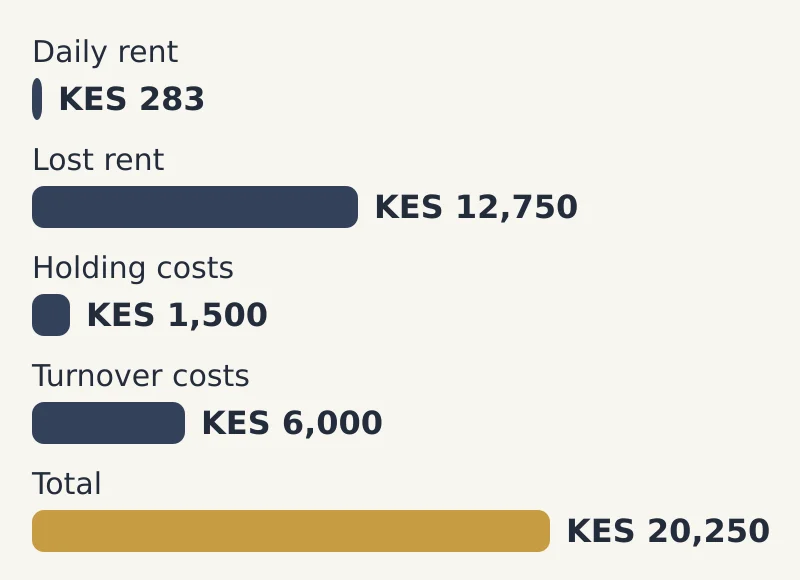
That is more than two months of rent gone on one move-out. On a yearly rent of KES 102,000, you have lost about 20%.
Worked example 2: a 2 bedroom apartment
Across all areas on ISHI Homes, the median rent for a 2 bedroom apartment is KES 28,000 a month, as of 26 Oct 2026.
Say it sits empty for 60 days and needs a full repaint.
| Item | Working | Amount |
|---|---|---|
| Lost rent | 28,000 × 2 months | KES 56,000 |
| Holding costs | KES 3,000 a month × 2, example | KES 6,000 |
| Turnover costs | repaint and repairs, example | KES 15,000 |
| Total | KES 77,000 |
Yearly rent is KES 336,000, so this one vacancy costs about 23% of the year's income. Cut the empty time to 15 days and lost rent drops to KES 14,000.
Worked example 3: holding out for higher rent in Kilimani
This is where many landlords lose money without noticing.
On ISHI Homes, the median rent for a 2 bedroom apartment in Kilimani is KES 71,500 a month, as of 26 Oct 2026. Say you want KES 75,000 instead, and asking the higher price keeps the unit empty one extra month.
- Extra rent you hope to gain: KES 3,500 a month
- Rent lost from one extra empty month: KES 75,000
Break-even months = Rent lost from extra vacancy ÷ Extra monthly rent
75,000 ÷ 3,500 = about 21 months.
The tenant would need to stay almost two years just for you to get back to where you would have been at KES 71,500. If they leave sooner, you lose. Before you push the rent up, run this check.
Worked example 4: a block of 1 bedroom units
For agencies and landlords with many units, small delays add up.
On ISHI Homes, the median rent for a 1 bedroom apartment in Roysambu is KES 18,250 a month, as of 26 Oct 2026. Say you manage a block where 6 tenants move out in a year.
| Average days empty per move-out | Lost rent per move-out | Lost rent for 6 move-outs |
|---|---|---|
| 30 days | KES 18,250 | KES 109,500 |
| 10 days | KES 6,083 | KES 36,500 |
Cutting empty time from 30 days to 10 saves about KES 73,000 a year in rent alone, before you count holding costs.
Quick reference: what one empty day costs
Using ISHI Homes median rents across all areas, as of 26 Oct 2026:
| Unit type | Median rent | Cost per empty day | Cost per empty week |
|---|---|---|---|
| Bedsitter | KES 8,500 | KES 283 | KES 1,983 |
| 1 bedroom apartment | KES 15,750 | KES 525 | KES 3,675 |
| 2 bedroom apartment | KES 28,000 | KES 933 | KES 6,533 |
| 3 bedroom house | KES 45,000 | KES 1,500 | KES 10,500 |
The 3 bedroom house figure comes from a single listing, so treat it as a rough guide.
How to cut your vacancy cost
Start before the tenant leaves
- Begin advertising as soon as you get notice to vacate.
- Ask the outgoing tenant if you can show the unit, with fair warning.
Get the unit ready fast
- Inspect in the notice period so you know what repairs are needed.
- Line up your painter, plumber and cleaner in advance.
Price it right
- Compare your rent with similar units nearby. Run the break-even check above before asking more.
- A fair price that fills in a week often beats a high price that sits for a month.
Market it well
- Take clear, bright photos of every room.
- List the details tenants ask about: water, parking, security, distance to the main road.
Screen quickly but properly
- Have a simple checklist: ID, proof of income, a previous landlord's contact.
- A bad tenant can cost more than a few extra empty days, so do not skip checks.
Keep good tenants
- The cheapest vacancy is the one that never happens. Fix problems quickly, communicate clearly and be reasonable on renewals.
Track your vacancy numbers
You cannot reduce what you do not measure. For each unit, keep a record of the move-out date, the move-in date of the next tenant, and what you spent in between. After a year you will see which units stay empty longest and why.
See ISHI in action
ISHI helps landlords and agencies keep track of units, tenants and rent in one place, and you can list vacant units on ISHI Homes to reach people looking for a house in Nairobi and its commuter towns. Book a free demo at www.ishi.digital/contact, call 0116888777 or email hello@ishi.digital.
Questions people ask
How do I calculate vacancy cost as a landlord?
Divide monthly rent by 30 to get daily rent, then multiply by the days the unit is empty. Add the bills you pay while it is empty and the cost of cleaning, repairs and marketing to get the total.
Should I count the deposit as income during a vacancy?
No. A deposit is usually refundable to the tenant, so it is security, not income. Only count it if you lawfully keep part of it for damage or unpaid rent.
Is it better to lower rent or wait for a higher-paying tenant?
Use the break-even check: divide the rent you lose from extra empty time by the extra monthly rent you hope to gain. If the answer is more months than a tenant is likely to stay, lowering the price is the better choice.
What is a good vacancy rate for rental property?
The lower the better, but what is realistic depends on your area and unit type. Track your own days empty per year for each unit and aim to bring that number down over time.
How can I fill a vacant house faster in Nairobi?
Start advertising as soon as you get notice, prepare repairs early, price in line with similar units, use clear photos and screen applicants quickly with a simple checklist.
What costs do landlords pay when a house is empty?
Common ones are security, water standing charges, common area electricity, service charge and any loan repayments, plus cleaning, painting, repairs and advertising to get the unit let again.
Keep reading

Tenant screening in Kenya: checks that do not scare good tenants away
A practical guide for Kenyan landlords and agencies on fair, quick tenant screening that protects your rent and respects the Data Protection Act.
25 October 2026 · 7 min read
How to Fill a Vacant House Faster: A Simple Guide for Landlords
Every empty month costs you a full month of rent. Here is how Kenyan landlords and agencies can fill a vacancy fast with the right price, good photos, a clear listing and quick replies to viewing requests.
25 October 2026 · 7 min read
eTIMS for landlords and property managers: what it means for rent and commission invoices
A plain guide to KRA's eTIMS for Kenyan landlords and agencies. Who needs to issue eTIMS invoices, how it touches rent, service charge and commission, and how to get your records ready.
4 November 2026 · 5 min read