
Utility billing from sub meter readings: a fair, auditable method
A step-by-step method for landlords and agencies to bill water and power from sub meter readings, using dated photos, anomaly checks and approval so tenants trust every bill.
Utility bills cause more tenant complaints than almost anything else in rental property. A tenant sees a water bill double and wants to know why. If all you can say is "the caretaker read the meter," you lose the argument and the tenant's trust. This guide shows a simple, fair method for utility billing from sub meter readings. Every bill can be checked, explained and defended.
What a sub meter is
A sub meter is a meter that measures what one unit uses. It sits behind the main meter that the water company or Kenya Power reads for the whole building. The utility bills you, the landlord, for the main meter. You then share that cost among tenants based on what each sub meter shows.
The idea is simple. The trouble comes from how readings are taken, checked and turned into bills.
Why utility bills turn into disputes
Most disputes come from a few common problems:
- No proof of the reading. A number is written in a notebook, with nothing to show it is right.
- Readings on different days. One month is 28 days, the next is 35, so bills jump for no real reason.
- Typing mistakes. A reading of 1,252 entered as 1,525 creates a huge bill.
- Nobody checks before bills go out. Mistakes reach the tenant before anyone notices.
- Bills with no breakdown. The tenant sees a total but not the readings or the rate behind it.
The method below fixes each of these.
The method: seven steps
1. Record a starting reading at move-in
When a tenant moves in, read the meter with them present if possible. Take a clear photo. Write the reading into the move-in checklist and have the tenant sign it. This is the baseline. Without it, the first bill is always open to argument.
Do the same at move-out. The final reading settles the last bill before the deposit is refunded.
2. Fix a reading day
Pick one day each month, for example the 25th, and read every meter in the building on that day. Same day, same order, every month. This keeps billing periods close to the same length, so bills are easy to compare.
3. Take a photo of every reading
This is the most important step. For each meter, take one photo that clearly shows:
- The full reading on the dial or display
- The meter serial number, or a label with the unit number
The photo should carry the date and time it was taken. A photo turns "trust me" into "see for yourself." If a tenant questions a bill, you can show them the exact meter on the exact day.
4. Work out consumption
Consumption is simple subtraction:
This month's reading - last month's reading = units used
Water is usually measured in cubic metres (1 cubic metre is 1,000 litres). Electricity is measured in kilowatt-hours, often called "units."
5. Run anomaly checks
An anomaly is a reading that looks wrong or unusual. Check every reading before any bill is made. The table shows the main checks.
| Check | What it looks like | What to do |
|---|---|---|
| Reading went down | This month is lower than last month | Almost always a typing error or wrong meter. Look at the photo. |
| Big jump | Use is far above the unit's normal, e.g. double its 3-month average | Check the photo, then check for a leak or running toilet. |
| Zero use | No change while the unit is occupied | Meter may be stuck or broken. Inspect it. |
| Use in an empty unit | Units are being used with no tenant | Possible leak, tap left open or illegal connection. |
| Photo does not match | The number typed differs from the photo | Correct it from the photo. |
| Main meter gap | Sub meters add up to much less than the main meter | Possible leak in shared pipes, or an unmetered connection. |
Flagged readings are not always wrong. A tenant may have had guests for a month. The point is that a person looks before the bill goes out.
6. Approve before billing
Split the work between two people. A caretaker or meter reader takes the readings and photos. A property manager or the landlord reviews them, clears or fixes each flag, and approves the batch. Only approved readings become bills.
This "two pairs of eyes" step catches most mistakes. It also protects your staff: if a reading is questioned, the record shows who took it and who approved it.
7. Send a clear bill
Every bill should show:
- Previous reading and date
- Current reading and date
- Units used
- Rate per unit
- Any shared or fixed charge, and how it was worked out
- Total due and the payment deadline
- A link to, or offer of, the meter photo
A tenant who can see the numbers rarely argues about them.
Setting a fair rate
The tariff is the price per unit the utility charges you. The fairest and simplest approach is to pass that cost on to tenants at the same rate, with no mark-up.
Tariffs can change, and some utility bills include fixed charges or bands where the price per unit rises with higher use. Read your actual bill each month and set the tenant rate from it, not from memory.
Before you charge anything above cost, check the rules. Talk to your water company and, for electricity, Kenya Power and the energy regulator (EPRA) about what landlords are allowed to charge and whether any permission is needed.
Handling shared costs
The main meter will almost always read more than all the sub meters added together. The difference covers things like the caretaker's tap, cleaning, a garden or small leaks.
Decide in advance how to handle this, and write it into the tenancy agreement. Common options:
- Landlord absorbs it as part of running the building.
- Equal split of the difference across all occupied units.
- Split in proportion to each unit's use.
Whatever you choose, show it on the bill as a separate line. Never hide it inside the rate per unit.
A worked example
The numbers here are only to show the method. They are not real tariffs.
Unit B4, water:
- Reading on 25 September: 1,240
- Reading on 25 October: 1,252
- Units used: 1,252 - 1,240 = 12 cubic metres
- Example rate: KES 150 per cubic metre
- Water charge: 12 x KES 150 = KES 1,800
- Shared common-area charge (equal split): KES 200
- Total: KES 2,000
Now suppose the reader had typed 1,525 instead of 1,252. Use would show 285 cubic metres and a bill of over KES 42,000. The "big jump" check flags it, the reviewer opens the photo, sees 1,252 and fixes it. The tenant never sees the wrong bill.
When a meter is broken or cannot be read
Sometimes a meter is broken, covered or locked away. In that case:
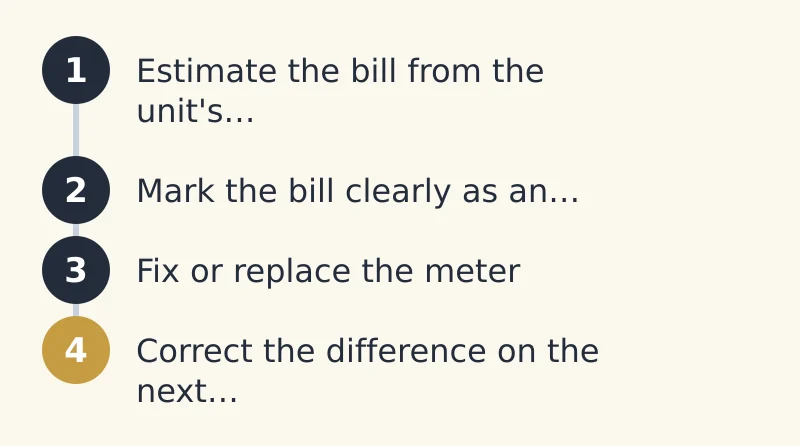
- Estimate the bill from the unit's average over the last three months.
- Mark the bill clearly as an estimate.
- Fix or replace the meter.
- Correct the difference on the next bill once a real reading is taken.
Never let estimates run for months. They are a short-term fix, not a method.
Handling a tenant dispute
When a tenant questions a bill:

- Share the photo of the reading and the previous one.
- Walk through the subtraction and the rate.
- If the reading is right but use is high, offer to check for leaks together.
- If you made a mistake, correct it fast and say so.
With photos and an approval record, most disputes end in minutes.
Keep records
Keep every reading, photo, approval and bill for each unit, along with the main utility bills. Good records help with tenant disputes, deposit refunds at move-out, spotting slow leaks over time, and showing owners exactly where money went.
How ISHI helps
Doing all this on paper or in a spreadsheet is possible, but slow. ISHI property management software builds the method into daily work:
- Caretakers capture each reading with a photo on their phone.
- Readings are checked automatically for drops, jumps, zero use and other anomalies.
- A manager reviews flagged readings and approves the batch.
- Approved readings turn into clear tenant bills, with the full history kept for each unit.
See ISHI in action
Want fair, auditable utility billing across all your properties? Book a free demo at www.ishi.digital/contact, call 0116888777 or email hello@ishi.digital. We will show you how readings, checks and approvals work from start to finish.
Questions people ask
What is a utility sub meter?
A sub meter measures the water or electricity used by one unit. It sits behind the building's main meter, which the utility uses to bill the landlord.
How often should sub meters be read?
Once a month, on the same day every month. A fixed reading day keeps billing periods similar in length so bills are easy to compare.
Can a landlord charge tenants more than the utility rate?
The safest and fairest approach is to pass on the utility's rate with no mark-up. Check with your water company, Kenya Power and EPRA before charging anything above cost.
What should I do if a sub meter is broken?
Bill an estimate based on the unit's last three months, mark it clearly as an estimate, fix the meter, then correct the difference once a real reading is taken.
Why do the sub meters not add up to the main meter?
The gap usually covers common-area use such as cleaning or a caretaker's tap, plus small leaks. A large or growing gap can point to a leak or an unmetered connection.
Should tenants be able to see meter photos?
Yes. Sharing the dated photo of each reading is the quickest way to settle a dispute and build trust in your bills.
Keep reading

Rainy season checklist for landlords: roofs, gutters, drainage and damp
A practical rainy season checklist for Kenyan landlords. What to inspect on the roof, gutters, drains and walls before and during the rains, and how to handle tenant reports fast.
3 November 2026 · 5 min read
Maintenance request system: a simple guide for landlords and agencies
A step-by-step maintenance request system for Kenyan landlords and agencies, from the tenant's first report to a fix you can prove with before and after photos.
25 October 2026 · 7 min read
eTIMS for landlords and property managers: what it means for rent and commission invoices
A plain guide to KRA's eTIMS for Kenyan landlords and agencies. Who needs to issue eTIMS invoices, how it touches rent, service charge and commission, and how to get your records ready.
4 November 2026 · 5 min read